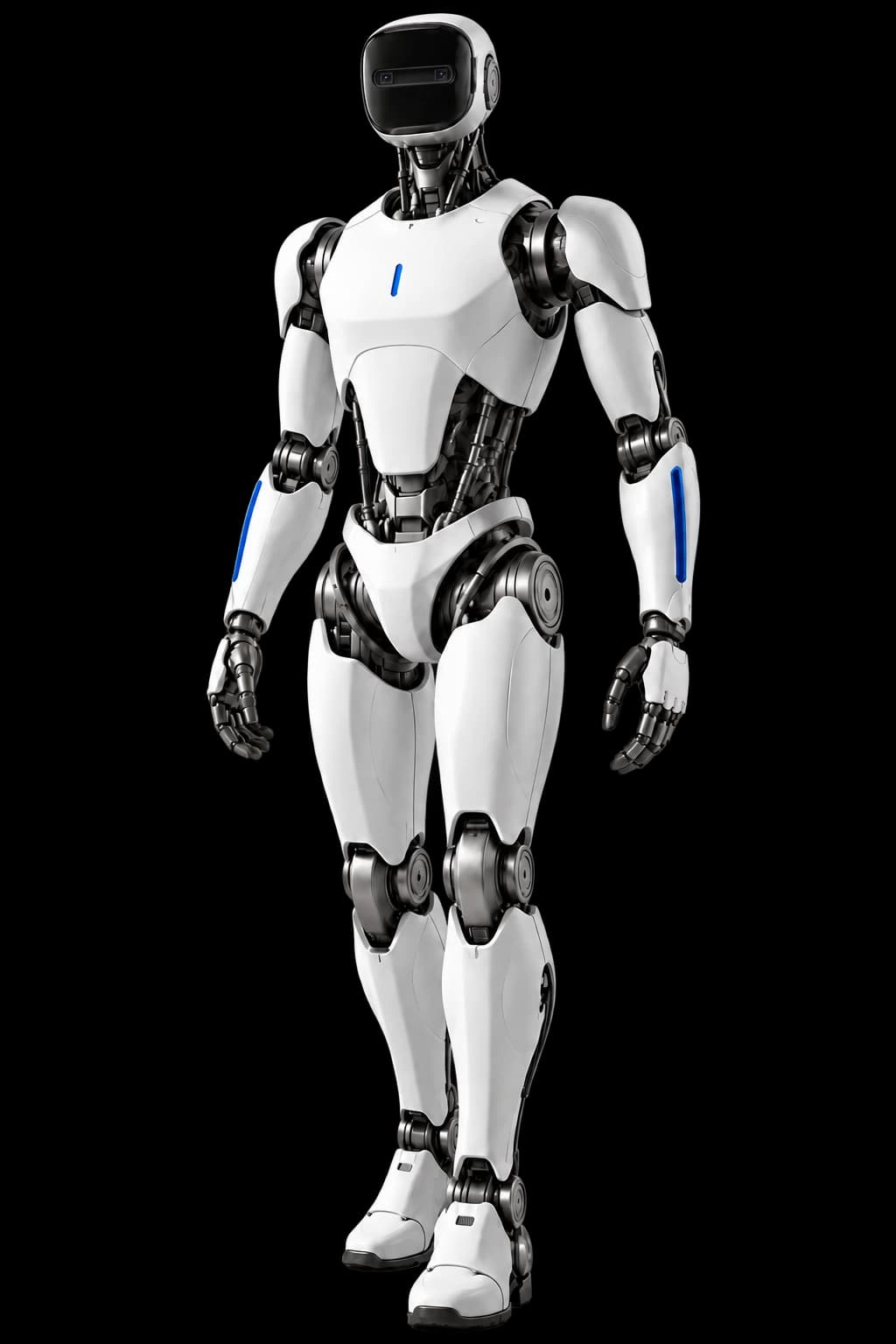
Designed around contact,
movement and the spaces
we already inhabit.
The complete body
A human-scale structure brings perception, manipulation and movement together. Follow the assemblies that make up its physical design.
Mechanics,
made visible.
The design lives at the junctions.
Where a shell ends, a joint begins.
Where a movement becomes contact.
The contact point.
Individual digits. Defined contact surfaces. A mechanical interface shaped around the object.
Protection meets articulation.
Continuous panels cover the frame. Open joints reveal where the structure needs to move.
The assembly expresses an industrial design direction. Physical performance and deployment readiness have not been validated.
K1 at work.
Start with the work between people, objects and places.
Three tasks. One physical platform.
From tray to fixture.
Move a small machined part from a prepared tray into a fixed nest. The work surface and destination stay known; an operator confirms the placement.
Follow the control loopMachined component
Locate · align · place
Operator checks placement
You define
the next move.
Physical intelligence starts with a shared understanding of the task. Set the scope, review uncertainty and stay part of the handoff.
Explore a supervised pilot- Define
- Perceive
- Review
- Act
Your task. Your boundaries.
Assign the selected task to begin the illustrative control sequence.
Illustrative interaction. Physical operation would require validated controls and supervision.
What would
you put in
its hands?
Describe one environment and one repeatable task. Build a brief for a focused pilot exploration.
One environment.
One defined task.
A useful pilot begins with a repeatable task, a clear environment and a team who knows the work.